Data Structures
~/victorpierre.dev ❯ cat learning/programming/data-structures/arrays.md
Arrays
Definition and Characteristics
- Linear Data Structure: An array is a collection of elements that are stored in contiguous memory locations.
- Indexed: Each element in an array is identified by an array index, starting from 0 in most programming languages.
- Homogeneous: All elements in a standard array are of the same type, which allows for efficient access to elements.
Types of Arrays
- One-Dimensional Arrays: The simplest form of an array, representing a linear sequence of elements. For example,
[10]int;in Go declares an array of 10 integers.
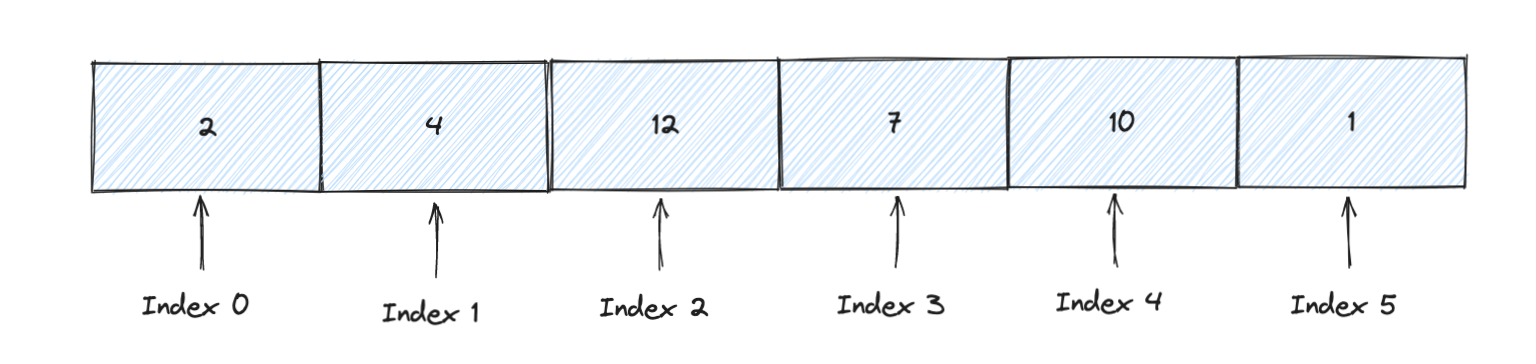
var myArray [6]int

myArray[0] = 2
myArray[1] = 4
myArray[2] = 12
myArray[3] = 7
myArray[4] = 10
myArray[5] = 1
  graph TD;
    subgraph Array
    0((0)) --> A[2]
    1((1)) --> B[4]
    2((2)) --> C[12]
    3((3)) --> D[7]
    4((4)) --> E[10]
    5((5)) --> F[1]
    end
- Multi-Dimensional Arrays: Arrays with more than one level of indexing, commonly used to represent matrices or grids. For example, a 2D array can be declared as
var matrix [3][3]intin Go. e.g.
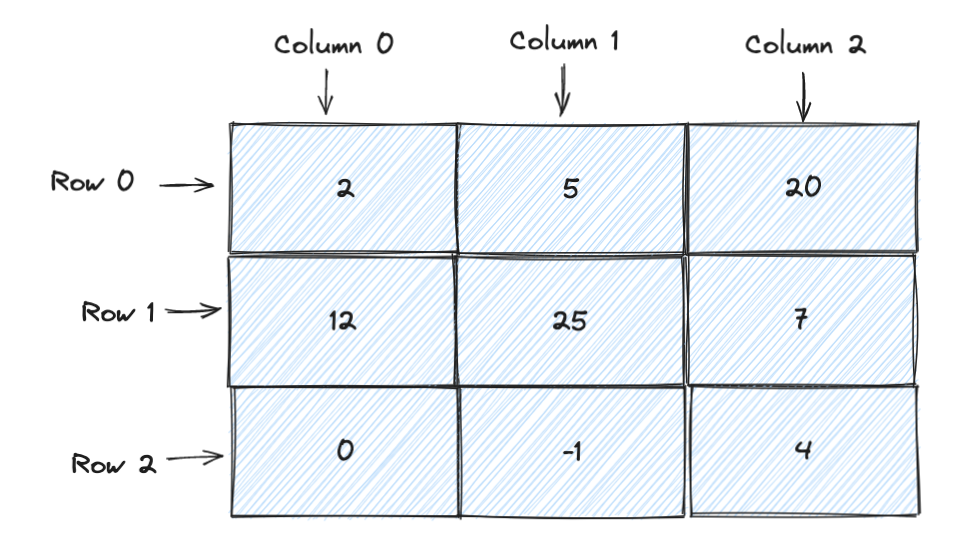
    matrix = [3][3]int{
        {2, 5, 20},
        {12, 25, 7},
        {0, -1, 4},
    }
  graph TD;
    subgraph Matrix
    00((0,0)) --> A[2]
    01((0,1)) --> B[5]
    02((0,2)) --> C[20]
    10((1,0)) --> D[12]
    11((1,1)) --> E[25]
    12((1,2)) --> F[7]
    20((2,0)) --> G[0]
    21((2,1)) --> H[-1]
    22((2,2)) --> I[4]
    end
Operations and Properties
Note that this table generally applies to simple, fixed-size arrays. Dynamic arrays (like slices in Go) might have different complexities due to resizing operations.
| Operation | Time Complexity | Comments |
|---|---|---|
| Access | O(1) | Constant time due to direct indexing. |
| Search | O(n) | Linear search is O(n); however, if the array is sorted, binary search can be O(log n). |
| Insertion | O(n) | Inserting at the end is O(1) for dynamic arrays (amortized), but O(n) for fixed-size arrays due to shifting elements. |
| Deletion | O(n) | Deleting the last element is O(1), but O(n) for other positions due to shifting elements. |
| Appending | O(1)* | Generally, appending is O(1), but if a dynamic array needs to resize, it’s O(n). This is amortized O(1) over many append operations. |
| Size | O(1) | Determining the size of an array is a constant time operation. |
| Traversal | O(n) | Traversing all elements in an array is O(n). |
- Accessing Elements: Constant time operation (O(1)) because elements are stored in contiguous memory locations. Access is done via the index, like
arr[3]. - Insertion/Deletion: Generally not efficient in basic arrays as it involves shifting elements. This is an O(n) operation, where n is the number of elements in the array.
- Size: In most static array implementations, the size is fixed and determined at the time of declaration. Dynamic arrays or vectors (like those in C++ STL or Java ArrayList) can adjust their size during runtime.
Advantages
- Simplicity: Easy to understand and use.
- Efficient Access: Due to contiguous memory allocation and indexing, reading elements is very efficient.
- Cache Friendly: Due to contiguous memory usage, arrays make better use of CPU cache.
Disadvantages
- Fixed Size: The size of static arrays is fixed, which can lead to either wasted space or insufficient capacity.
- Poor Insertion/Deletion Performance: Requires shifting elements, which is inefficient for large arrays.
Applications
- Used as the building block for many other data structures like heaps, hash tables, etc.
- Efficient for scenarios where random access is more frequent than insertion/deletion.
- Useful in algorithms that require sequential or fixed-size storage, like sorting algorithms.
Implementation Considerations
Most high-level languages ship a more flexible take on arrays: slices in Go, lists in Python, ArrayList in Java. All dynamic arrays that grow and shrink at runtime.